

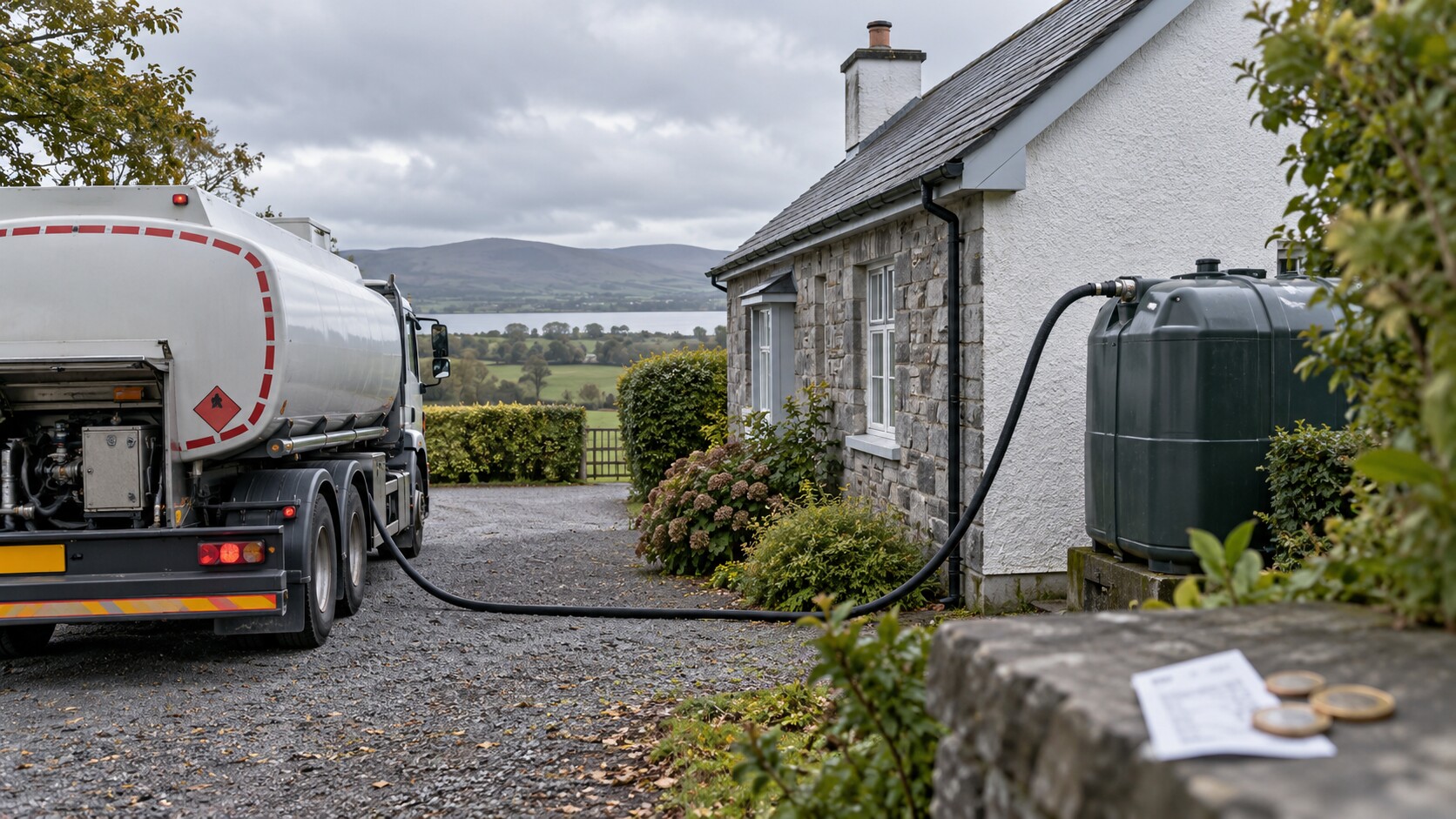
Ireland heating oil prices have climbed sharply ahead of winter, with households facing a bill of approximately €1,450 or more for 1,000 litres of kerosene.
Prices vary by county, supplier, delivery size and the time a quotation is requested. Recent national trackers have placed the cost of a 1,000-litre delivery between approximately €1,440 and €1,480 across many parts of the country.
The increase is creating additional financial pressure for households that rely on oil for space heating and hot water, particularly as colder weather approaches.
Quick Answer: How Much Does Heating Oil Cost in Ireland?
Recent price comparisons show that 1,000 litres of kerosene heating oil costs around €1,450 to €1,480 in many Irish counties. A 500-litre order costs approximately €730 on average, although individual supplier quotes can be higher or lower.
Ireland heating oil prices change frequently. Customers should compare several local suppliers on the day they plan to order instead of relying on an older national average.
Current Ireland Heating Oil Prices by County
The following figures provide a recent snapshot of reported prices for a 1,000-litre kerosene delivery. They should be treated as a guide rather than a guaranteed quote.
| County | Approximate price for 1,000 litres |
|---|---|
| Donegal | €1,443 |
| Kilkenny | €1,449 |
| Sligo | €1,450 |
| Leitrim | €1,451 |
| Monaghan | €1,454 |
| Carlow | €1,461 |
| Galway | €1,462 |
| Cork | €1,463 |
| Cavan | €1,463 |
| Longford | €1,469 |
| Kerry | €1,469 |
| Clare | €1,470 |
| Kildare | €1,470 |
| Mayo | €1,471 |
| Meath | €1,471 |
| Roscommon | €1,472 |
| Dublin | €1,473 |
| Offaly | €1,476 |
| Laois | €1,480 |
| Limerick | €1,483 |
These figures were available through OilPrices.ie, which collects kerosene quotations from suppliers across Ireland.
Prices can change during the day. Delivery location, order volume, payment method and individual supplier conditions may also affect the final amount.
Which Counties Have the Cheapest Heating Oil?
In the latest available comparison, Donegal, Kilkenny, Sligo and Leitrim were among the counties with lower reported prices for a 1,000-litre order.
However, the cheapest county can change quickly. A supplier offering the lowest price today may not remain the cheapest after wholesale costs, demand or delivery schedules change.
Why Prices Differ Between Counties
Heating oil prices can vary by location for several reasons:
- The number of suppliers operating locally
- Distance between the distribution depot and delivery address
- Competition between oil companies
- Delivery costs
- Local demand
- Order size
- Wholesale kerosene prices
- International oil-market conditions
Households in rural areas may have fewer nearby suppliers, although this does not always mean they will pay the highest price.
How Much Have Ireland Heating Oil Prices Increased?
Recent reporting indicated that the average cost of filling a standard 1,000-litre household tank reached approximately €1,444 in early September.
That represented an increase of around 59% compared with the same period in the previous year, according to RTÉ’s report on home-heating oil prices.
Historical data also demonstrates how volatile the market has been. During 2026, the reported national average for 1,000 litres ranged from below €930 in January to more than €1,770 during an April peak.
This variation makes the timing of an order important, although it is impossible for households to predict short-term price movements with certainty.
Why Are Ireland Heating Oil Prices Rising?
Several domestic and international factors can influence the amount Irish households pay for kerosene.
International Oil-Market Volatility
Ireland imports much of the energy it uses, leaving the country exposed to changes in international fuel prices.
Conflict, supply disruption, changes in global demand and uncertainty surrounding major shipping routes can quickly affect wholesale energy markets.
The Sustainable Energy Authority of Ireland has warned that Ireland’s continued reliance on imported fossil fuels leaves the country vulnerable to global energy price shocks.
Exchange-Rate Movements
Oil is generally traded internationally in US dollars. Changes in the value of the euro against the dollar can therefore influence the cost paid by importers.
A weaker euro can make imported fuel more expensive, even when the underlying dollar price of oil has not increased significantly.
Seasonal Demand
Demand often increases as households prepare for autumn and winter. A sudden rise in orders can affect supplier availability and delivery schedules.
Customers who wait until their tanks are almost empty may have less flexibility to compare prices or delay an order during a temporary increase.
Taxes and Distribution Costs
Taxes, storage, transport and supplier operating expenses all contribute to the final price paid by households.
A change in wholesale oil prices may not appear immediately or equally across every supplier because companies purchase fuel at different times and manage different costs.
How to Pay Less for Heating Oil in Ireland
Households cannot control international energy markets, but they can take practical steps to manage their heating costs.
Compare Several Suppliers
Request quotations from multiple suppliers serving the local area. The difference between quotes can become meaningful on a 500-litre or 1,000-litre order.
When comparing prices, confirm whether VAT and standard delivery are included.
Compare Different Order Sizes
A larger order often has a lower price per litre, but the total upfront payment will be higher.
Households should compare the cost per litre for different quantities rather than assuming that the largest order is automatically the best choice.
A smaller delivery may be more manageable for the household budget even if its price per litre is slightly higher.
Consider a Local Buying Group
Heating-oil buying groups combine orders from several households in one area. A larger combined delivery may help the group negotiate a better price or reduce delivery costs.
The saving is not guaranteed, so participants should still compare the group price with independent quotations.
Monitor the Tank Level
Checking the tank regularly can reduce the risk of an emergency order. Automatic monitors and simple dipsticks can help households estimate how much fuel remains.
Ordering before the tank becomes critically low provides more time to compare suppliers.
Check the Final Quote Carefully
Before confirming an order, households should verify:
- The quantity being delivered
- The total price
- The price per litre
- Whether VAT is included
- The delivery date
- Any payment or delivery fees
- The supplier’s cancellation policy
Customers should obtain confirmation of the order and retain the receipt after delivery.
How to Reduce Heating-Oil Consumption
Reducing wasted heat can help a delivery last longer, although households should not allow their homes to become dangerously cold.
Lower the Thermostat Carefully
The Sustainable Energy Authority of Ireland advises setting living-area thermostats at approximately 20°C, with cooler temperatures in halls and bedrooms.
SEAI states that lowering room temperature by one degree may reduce a heating bill by around 10%.
Older people, infants and anyone with a health condition may need warmer indoor temperatures. Health and safety should take priority over saving energy.
Heat Rooms According to Use
Radiator valves can be lowered or turned off in rooms that are rarely used. Doors between heated and unheated areas should be kept closed where practical.
Frequently used rooms should remain comfortably and safely heated.
Use Heating Controls
Timers, thermostats and heating zones can reduce the amount of fuel used when nobody is home or during periods when full heating is unnecessary.
Controls should match the household’s routine rather than running the heating continuously without adjustment.
Reduce Heat Loss
Closing curtains after dark, sealing appropriate draughts and maintaining doors and windows can help retain heat.
Homeowners considering larger upgrades may also investigate attic insulation, wall insulation, heating controls and other SEAI-supported improvements.
Ventilation openings should never be blocked, as adequate ventilation is necessary for safety and indoor air quality.
Service the Boiler
A properly maintained boiler may operate more efficiently and safely. Households should use a suitably qualified technician and follow the manufacturer’s servicing recommendations.
Unusual smells, smoke, soot or repeated boiler shutdowns should be investigated promptly.
Can Fuel Allowance Help With Heating-Oil Costs?
Fuel Allowance is a means-tested payment designed to help eligible households with winter heating expenses. It is not restricted to one particular heating source.
The weekly Fuel Allowance rate is €38 during the 2026/27 season. Eligible recipients may receive it weekly or through two lump-sum payments.
Lost Society’s complete Fuel Allowance Ireland 2026/27 guide explains the payment dates, qualifying conditions, income assessment and application process.
Receiving another social welfare payment does not automatically guarantee eligibility. Applicants should check the official conditions that apply to their circumstances.
Could Budget 2027 Include More Energy Support?
Rising Ireland heating oil prices are likely to add to calls for further household energy support ahead of Budget 2027.
However, proposals, political demands and media reports should not be treated as confirmed government policy. The final measures will only become clear when the Budget is presented and the relevant rules are published.
Lost Society’s guide to Budget 2027 Ireland explains what has already been confirmed and which possible cost-of-living measures remain uncertain.
Households should avoid planning their winter budgets around payments that have not been formally announced.
Why Higher Heating Costs Affect the Wider Household Budget
A sharp rise in heating costs can reduce the amount available for groceries, transport, clothing and other essential expenses.
Families may experience particular pressure during the start of the school year, when heating preparation overlaps with uniforms, books, transport and other education costs.
Lost Society’s breakdown of back-to-school costs in Ireland provides additional guidance for families managing these overlapping expenses.
Creating a monthly household budget can make the trade-offs clearer and help identify bills that can be adjusted before winter.
What Should Households Do Before Ordering?
Before placing a heating-oil order:
- Check the current tank level.
- Decide how much oil the household can afford.
- Request several local quotations.
- Compare the price per litre and total price.
- Confirm that all charges are included.
- Ask for the expected delivery date.
- Check whether the household qualifies for Fuel Allowance.
- Review practical ways to reduce unnecessary heat loss.
Households struggling to afford sufficient heating should seek information about available welfare support rather than allowing their homes to become unsafe.
Frequently Asked Questions About Ireland Heating Oil Prices
How Much Does 1,000 Litres of Heating Oil Cost in Ireland?
Recent quotations have placed the price at approximately €1,450 to €1,480 in many counties. The exact amount changes frequently and depends on the supplier and location.
How Much Does 500 Litres of Heating Oil Cost?
A 500-litre delivery recently averaged around €730 nationally. Smaller orders often cost more per litre than larger deliveries.
Which County Has the Cheapest Heating Oil?
The answer changes as suppliers update their prices. Donegal, Kilkenny, Sligo and Leitrim appeared among the lower-priced counties in a recent comparison.
Is It Cheaper to Order 1,000 Litres?
The price per litre may be lower for a 1,000-litre order, but the total upfront cost is considerably higher. Customers should compare both the unit price and the amount they can afford.
How Often Do Heating-Oil Prices Change?
Prices can change daily and sometimes more frequently during periods of market volatility. A quotation should be confirmed directly with the supplier before ordering.
Can Fuel Allowance Be Used for Heating Oil?
Fuel Allowance helps eligible households with winter heating costs and is not limited to gas or electricity. Applicants must satisfy the qualifying conditions.
Will Heating-Oil Prices Fall Again?
Prices may rise or fall in response to wholesale markets, international events, exchange rates and seasonal demand. Short-term movements cannot be predicted reliably.
Final Thoughts on Ireland Heating Oil Prices
Ireland heating oil prices have returned to approximately €1,450 or more for a 1,000-litre delivery, placing renewed pressure on household winter budgets.
The exact amount varies by county and supplier, so comparing quotations remains one of the most practical ways to avoid overpaying. Monitoring the tank, using heating controls carefully and reducing preventable heat loss may also help households manage their fuel use.
Eligible households should review Fuel Allowance rules, while all consumers should rely on current supplier quotations because heating-oil prices can change rapidly.